
IBC 2016 · Regulation 35 · IBBI Registered Valuer
CIRP Valuation by Registered
Mandatory liquidation value and fair value reports for Corporate Insolvency Resolution Process. Delivered within regulatory timelines. Accepted by NCLT, banks, and resolution professionals across India.
Get Your CIRP Valuation Started
Respond within 5 business hours · Confidential
Statutory mandate
What Is CIRP Valuation — and Why Is It Mandatory?
CIRP valuation is a mandatory statutory assessment under the Insolvency and Bankruptcy Code (IBC) 2016. It determines two values — liquidation value and fair value of a corporate debtor’s assets during insolvency proceedings. Under Regulation 35 of IBBI (CIRP) Regulations 2016, the Resolution Professional must appoint two IBBI-registered valuers who submit independent reports within 45 days.
REG. 35(1)
The Resolution Professional shall within seven days of the insolvency commencement date, appoint two registered valuers to determine the liquidation value and fair value of the corporate debtor. Both reports are submitted independently, and the average of the two forms the basis for creditor and CoC decision-making.
The Two Mandatory Values in Every CIRP
Value Type 01
Liquidation Value
The estimated realisable value of the corporate debtor’s assets if sold in a distressed, time-bound scenario. Used as the floor value below which no resolution plan can be accepted by the Committee of Creditors (CoC). Typically lower than fair value due to market conditions and urgency.
Value Type 02
Fair Value
The estimated realisable value in an open, unrestricted market under normal sale conditions. Used by resolution applicants and the CoC to evaluate resolution plans. Reflects the asset’s true economic worth without the distress discount applied in liquidation value.
Both valuations must be submitted by independently appointed, IBBI-registered valuers — not the same firm, and not connected to either the corporate debtor or any creditor. RNC Valuecon LLP maintains independence protocols strictly in line with IBBI Valuation Professionals Regulations 2017.
Our Process
How We Conduct a CIRP Valuation
From mandate assignment to report submission — a clear, regulated process with defined milestones that protect your resolution timeline.
Scope of services
CIRP Valuation Services We Provide
Covering all three IBBI asset classes and associated insolvency-related valuations required under IBC and related frameworks.
🏗️ Plant & Machinery Valuation
Complete valuation of manufacturing equipment, industrial plant, and machinery for CIRP. Covers depreciated replacement cost and market-comparable approaches.
🏢 Land & Building Valuation
Real estate, land parcels, commercial and industrial properties. Market approach backed by comparable registered transactions and government guideline analysis.
📊 Securities & Financial Assets
Equity shares, debentures, financial instruments, and business enterprise value during CIRP. DCF, earnings multiples, and NAV-based approaches applied.
🔄 Going Concern Valuation
Valuation of the corporate debtor as a going concern, used when resolution applicants seek to continue business operations post-resolution.
💰 Liquidation Valuation
Distressed-sale asset valuation for companies proceeding to liquidation under Section 33 of IBC. Supports the liquidator in maximising realisations.
🏦 SARFAESI & NPA Valuation
Valuation for banks and NBFCs under the SARFAESI Act for secured asset enforcement, distressed loan book valuation, and NPA resolution.
Clients
Who Appoints RNC Valuecon for CIRP Valuation?
We work with all stakeholders in the IBC ecosystem — from resolution professionals and creditors to banks, tribunals, and legal counsel.
⚖️ Insolvency Professionals (IPs)
Resolution Professionals mandated under IBBI to appoint registered valuers under Regulation 35.
🏦 Banks & NBFCs
Financial creditors initiating CIRP under Section 7 of IBC for NPA recovery and debt resolution.
🏛️ NCLT & NCLAT
Tribunal-directed valuations and second-opinion reports in contested CIRP and liquidation matters.
🤝 Resolution Applicants
Corporates and private equity firms bidding for distressed assets who need independent asset value assessment.
📋 Committee of Creditors
CoC members requiring independent validation of resolution plan value vs liquidation value floor.
⚖️ Legal Counsel & Law Firms
Litigation support, expert witness valuation reports, and valuation opinions for IBC dispute resolution.
Frequently Asked Questions
CIRP Valuation — Common Questions
What is CIRP valuation under IBC?
CIRP valuation is a statutory requirement under Regulation 35 of IBBI (Insolvency Resolution Process for Corporate Persons) Regulations, 2016. Two IBBI-registered valuers are appointed by the Resolution Professional to independently determine the liquidation value and fair value of the corporate debtor’s assets. These values guide the Committee of Creditors in evaluating resolution plans.
What is the CIRP project value in 2025–26?
CIRP project value refers to the aggregate admitted claims or total asset value of corporate debtors admitted under insolvency proceedings at any point in time. As of 2025–26, thousands of CIRP cases are active across NCLT benches in India, with admitted claims cumulatively running into several lakh crore rupees. Each case requires independent registered valuer reports for both liquidation and fair value.
Who can conduct CIRP valuation in India?
Only valuers registered with IBBI under the IBBI (Valuation Professionals) Regulations 2017 can conduct CIRP valuations. Valuers must hold valid registration in the relevant asset class — Securities or Financial Assets (Class I), Land and Buildings (Class II), or Plant and Machinery (Class III). RNC Valuecon LLP’s principals hold IBBI registration across all three asset classes.
How long does a CIRP valuation take?
Under Regulation 35, the registered valuer must submit the report within 45 days of appointment. The RP may grant a further 10-day extension in exceptional circumstances. RNC Valuecon typically delivers preliminary reports within 30–35 days, allowing buffer time for any clarifications before final submission.
What is the difference between liquidation value and fair value in CIRP?
Liquidation value is the estimated amount realisable if assets are sold in a distressed, time-bound scenario — it serves as the floor below which no resolution plan can be accepted. Fair value is the estimated realisation under open market, normal conditions — it reflects the asset’s economic worth without distress discounts. Both are mandatory under CIRP, and no resolution plan may offer less than the liquidation value to dissenting creditors.
Can the same valuer conduct both valuations in CIRP?
No. Regulation 35 requires two independent registered valuers to be appointed separately. They must not be related to each other, to the corporate debtor, or to any financial creditor. Their reports are submitted independently, and the Resolution Professional takes the average of the two valuations as the basis for CoC deliberations.
How much does a CIRP valuation cost in India?
CIRP valuation fees vary based on the size and complexity of the corporate debtor’s assets, the number of asset classes involved, and the geographic spread of assets. For a single-asset, single-class CIRP, fees typically start from ₹1–2 lakhs per valuer. Multi-location, multi-class valuations are quoted on a case-by-case basis. Contact RNC Valuecon for a mandate-specific fee quote.
What are the new IVS requirements for IBC valuations from April 2026?
IBBI’s circular dated April 1, 2026 makes International Valuation Standards (IVS), issued by the IVSC (International Valuation Standards Council), mandatory for all IBC valuations with immediate effect. This replaces the previous dual-standards approach where CIRP used IVS but liquidation followed Companies (Registered Valuers) Rules, 2017.
Under IVS, all valuation reports must include: explicit basis of value, scope of work, methodology justification with documented rationale for approach selection, assumptions and limiting conditions, and supporting evidence. RNC’s reports are fully IVS-compliant from the April 2026 effective date.
From RNC Valuecon
Related Reading on CIRP Valuation
Practical guidance for resolution professionals, creditors, and corporate debtors navigating valuation requirements under IBC.
How to Appoint an IBBI Registered Valuer for CIRP
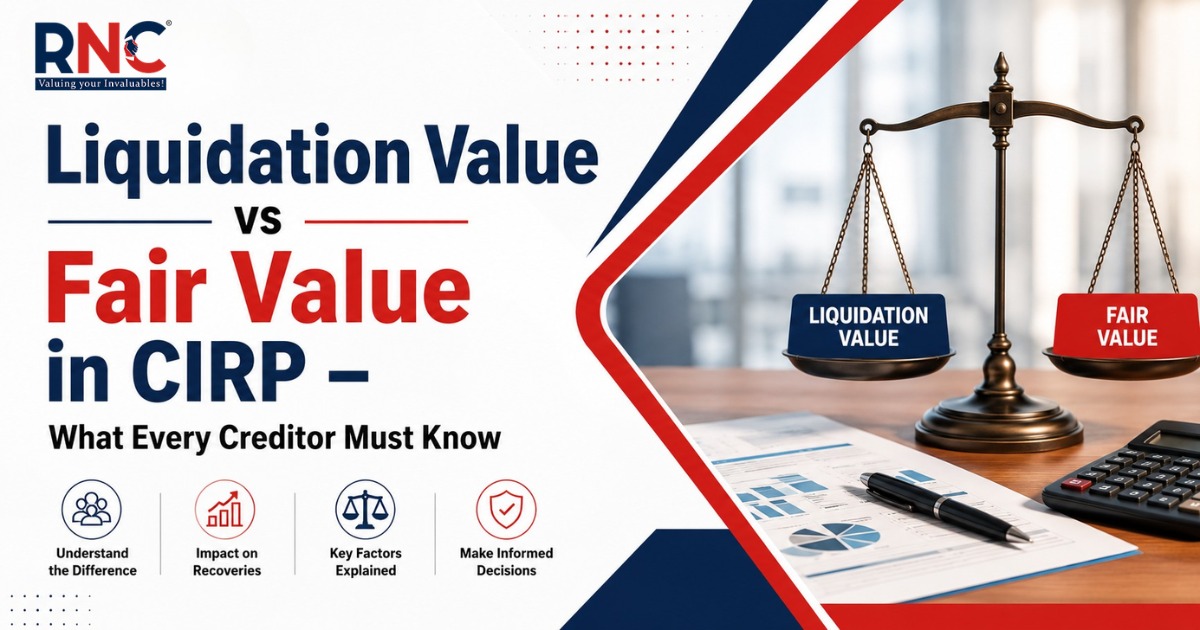
Liquidation Value vs Fair Value in CIRP: What Every Creditor Must Know
Assign your mandate today
Need an IBBI Registered Valuer for a CIRP Mandate?
Resolution timelines move fast. RNC Valuecon responds within 4 business hours, conducts a same-day conflict check, and delivers within the 45-day statutory window — every time.
RNC Valuecon LLP · IBBI Registered Valuer · IBC Regulation 35 Compliant